
Pure oils. Healthier families. A stronger India.

Groundnut, sesame, coconut, mustard and sunflower oils, cold-pressed from whole seeds and bottled without refining, bleaching or chemicals.

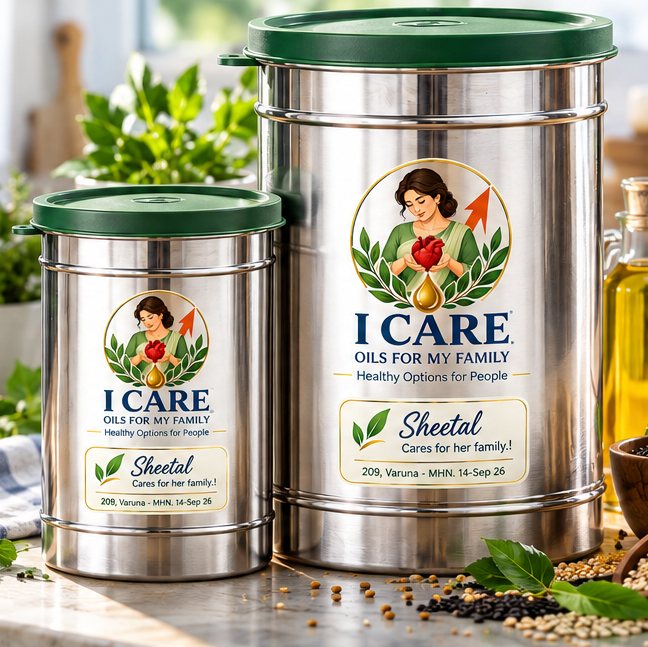
Two I Care stainless steel oil tins with green lids on a kitchen counter, with fresh herbs, seeds and a bottle of golden oil

What the label promises

Pressed
Cold, from whole seeds
Refined
Never
Additives
None
Traceable
Batch no. on every tin

A revolution in Indian oil consumption Taking health back into our own hands

At I Care, we didn’t just find a business gap to fill. We recognised a critical health need to be addressed.

We are committed to replacing processed, unhealthy oils with pure, traditional, unrefined alternatives for every Indian home.

Read our story
  • 100% Natural
  • Better Health
  • For Every Indian Family
  • A Healthier Tomorrow

Five oils, each suited to the way India cooks

Every oil brings its own flavour and belongs to its own regional kitchen. Choose by what you cook, not by what is on offer.

  1. Groundnut oil

    Mild and nutty. A dependable everyday oil, steady enough for tadka and shallow frying.

    Best for Daily cooking, tadka, shallow frying

  2. Sesame oil

    Rich and aromatic. The traditional gingelly oil of South Indian pickles, podis and tempering.

    Best for Pickles, podi rice, tempering

  3. Coconut oil

    Clean and gently sweet. Turns solid in cool weather, which is natural for pure coconut oil.

    Best for Kerala dishes, sweets, finishing

  4. Mustard oil

    Sharp, pungent and warming. The backbone of Bengali, Bihari and Punjabi cooking.

    Best for Fish curries, pickles, sarson ka saag

  5. Sunflower oil

    Light in colour and taste, so the spices lead. The most delicate of the five, best over gentle heat.

    Best for Gentle cooking, baking, dressings

From seed to tin, in five careful steps

A modern cold-press machine extracts oil with mechanical pressure alone. There are no solvents, no bleaching and no deodorising, so what goes into the tin is the oil itself.

  1. Choosing the seed

    Whole, mature seeds and dried copra are checked for moisture, damage and foreign matter before a lot is accepted. TODO confirm sourcing regions.

  2. Cleaning and drying

    Seeds are cleaned of dust, stones and husk, then dried so that excess moisture cannot spoil the oil later.

  3. Cold pressing

    The press crushes the seed slowly under mechanical pressure, with no external heat applied, keeping the oil below TODO °C.

  4. Natural settling

    Fresh oil rests so that fine seed particles sink on their own, without chemicals. Settling time: TODO

  5. Filtering and filling

    The clear oil is filtered, sealed into tins and bottles, and printed with a batch number that traces it to its pressing.

Cold-pressed and refined oil are not the same product

Both begin as seeds. What happens next decides what reaches your kitchen. Here is the difference stated plainly, including where refined oil has the advantage.

Cold-pressed oil compared with typical refined commercial oil
I Care cold-pressed Typical refined oil
How oil leaves the seed Mechanical pressing of whole seeds, with no external heat. High-temperature pressing, often followed by extraction with hexane, a petroleum solvent that is later distilled off.
What happens after Settled and filtered. Nothing else. Degummed, neutralised with caustic soda, bleached with clays, then deodorised with steam at roughly 200 to 250 °C.
Natural vitamin E and antioxidants Largely retained. Partly lost, especially during deodorising.
Trans fats from processing None formed, as no high-heat step is used. Small amounts can form during high-temperature deodorising.
Colour, aroma and taste Those of the seed: golden, nutty or fragrant, depending on the oil. Pale, neutral and almost odourless.
Smoke point Lower. Best for everyday cooking, tempering and shallow frying. Higher, so it tolerates long, high-heat deep frying. Advantage: refined
Shelf life Shorter. Best used within TODO months of pressing. Longer, often a year or more. Advantage: refined
Price Higher, because pressing yields less oil from each kilo of seed. Lower, because solvents draw out nearly all the oil. Advantage: refined

A general comparison of processing methods. Exact values vary by seed, press and refinery. TODO add source references before launch.

What stands behind every tin

  • FSSAI licensed

    Lic. No. TODO

  • Batch and lot tracked

    Printed on every tin, traceable to its pressing

  • Cold-pressed goodness

    Pressed mechanically, with no external heat and no solvents

  • No chemicals, no preservatives

    Nothing added to the oil: no colour, flavour or preservatives

  • Lab tested

    TODO confirm lab and tests

What families tell us

TODO Real customer quote. Ask what changed after switching: the taste of everyday food, how the family took to it, why they keep reordering.

Customer name TODO City, and the oil they use

TODO Second customer quote, ideally from a different city and a different oil.

Customer name TODO City, and the oil they use

TODO Third customer quote, for example about switching from refined oil for children or elderly parents.

Customer name TODO City, and the oil they use

From our kitchen

See all recipes

Kerala avial, finished with coconut oil

Mixed vegetables in a coconut and curd paste, with a spoon of cold-pressed coconut oil stirred in at the very end, when its fragrance matters most.

Oil
Coconut
Time
40 min
Serves
4

Macher jhol with mustard oil

A light Bengali fish curry, tempered with kalonji and green chillies in mustard oil.

Oil
Mustard
Time
35 min

For healthier, happier families

Tell us which oils and pack sizes you need and ask us for current pricing. We will get back to you on WhatsApp.

Delivery: currently within Hyderabad only.

Chat with I Care Oils on WhatsApp (opens in a new tab)